
What the coronavirus shutdown means for immigrant workers

Faced with indeterminate delays and circumstances changing by the day, businesses that rely on immigrant workers have been frantically communicating with their legal teams in recent weeks as the impact of the coronavirus pandemic has spread.

Diane Hernandez, a Denver-based lawyer at Hall Estill, said one university she works with was expecting a Chinese researcher to arrive March 1 to helm a large summer project. His H-1B visa was approved in December, but as his start day approached, he could not obtain the visa at the U.S. consulate in China because of the coronavirus-related travel ban. Now, the researcher, his family, and the university are all on hold, waiting to see what will happen.

“There will likely be issues when he finally does enter that will have to be dealt with, specifically getting some leeway from U.S. immigration on his entry date and having missed a number of weeks or months in his H-1B status,” says Hernandez, who has fielded many panicked emails from clients in the past few weeks.

The processing speed for employment visas, and immigration benefits in general, had already decelerated under the Trump administration, with more requests for additional documentation and other evidence that were not typical in the decades prior.

“Even before COVID-19, many of our partners in the business community were worried about USCIS [U.S. Citizenship and Immigration Services] processing of work-related immigration visas. Wait times, labor certifications, and other issues seemed to spring up at every turn,” says Ali Noorani, executive director of the National Immigration Forum.

Now, further delays are expected during the pandemic response, and employers and employees alike are faced with tough decisions.

“There are all kinds of ramifications. Some companies are worried about having work available for people to do, because the economy’s going downhill so quickly, and how to handle their staff in the best way,” says Susan Cohen of the Mintz law firm. “On the other side, some businesses are still desperate for people, key hires that they’ve gone to great trouble and expense to retain, and now their visa is approved, but they can’t get here. In some cases, we’re talking about executives and top managers.”

USCIS offices for in-person interviews, biometric appointments, and other activities are temporarily closed, but the agency service centers that handle things like the H-1B lottery process and visa adjudications are still operating.

“If they start laying people off or furloughing workers, or otherwise close the service centers where they do the adjudication, that would have a huge impact,” Hernandez says.

While employment, student, and other visa applications are moving forward, they will not be issued until consulates reopen to the public, and travel bans are lifted.

“For larger companies, it might not be such a big deal, but for the little startups that have fewer than 10 employees, to not have one team member can be really detrimental. The uncertainty is really tough on employers,” says San Francisco–based attorney Jennifer Burk.

Depending on the visa category, rules can vary widely. Furloughed H-1B employees, for example, must still be paid even if they are not working, as long as they are under contract. Laid-off visa holders typically have 60 days to adjust their status, such as securing a different job or enrolling in school, before they are required to leave the country.

From technology companies to medical services and food production, the COVID-19 pandemic is expected to strain a wide range of industries reliant on immigrant labor.

“One area of great concern these days is coming from agricultural interests who utilize the H-2A program,” Noorani says. “With harvest season looming and the State Department not conducting interviews, growers are worried about their labor supply.”

This year, USCIS implemented a brand-new H-1B lottery system that pushes the old April 1 deadline for final applications out to June 30. Meanwhile, USCIS recently suspended premium processing, which enables employers to pay $1,440 per application for a guaranteed response in 15 days, otherwise, a decision can take months.

“The new June deadline might offer more time, but it could end up as a negative for employers who can’t do premium processing, are not given the option, or can’t afford it,” Hernandez says. “That will likely push approval past the October 1 start of the new visa period. Someone who is converting from student to H-1B, for example, may run out of status before the new visa is approved and would be required to leave, then come back. It’s a whole domino effect.”

USCIS has made some allowances for filings, including a March 20 announcement to accept copies of signed I-9 work authorization forms in lieu of original documents until normal work-site operations resume.

“I tell my clients to take it day by day, because things are changing so fast. The best thing to do is document everything, keep track of what you’re doing and why,” Hernandez says. “I think that the government understands how detrimental it would be to totally cease processing work visas, not just to small entrepreneurs but to big companies like Microsoft that use tons of H-1B workers.”

By: Tovin Lapan. See https://fortune.com/2020/03/26/coronavirus-jobs-immigrants-us-work-visas-h1b-employment-immigration/
IMMIGRATION ALERT COVID-19 PANDEMIC

IMMIGRATION ALERT

The world is confronting the potentially deadly COVID-19 pandemic. Preliminary reports from the Center for Disease Control (CDC) indicate that the virus is primarily spread between people who are in close contact.  The virus can also be spread before people show symptoms. The virus can remain alive on surfaces–such as court tables–for days. The pandemic has caused the President to issue a national declaration of emergency.

To slow the spread of the virus the CDC advises individuals to increase their physical distance from other people to about 6 feet. Id. Consequently, social gatherings, business conferences, sporting events, and religious ceremonies have been canceled or postponed across the nation.

As the coronavirus situation continues to evolve, LAW OFFICES OF NORKA M. SCHELL, LLC is focused on ensuring the health and safety of our employees and their families.  At the same time, we remain committed to delivering the same level of service our clients expect and deserve.  We also aim to support our community with cutting-edge thought leadership throughout the coronavirus pandemic.

We maintain a business continuity plan designed to minimize significant business interruptions and facilitate uninterrupted service.  Precautionary actions include ongoing briefing on health recommendations and safety measures; banning non-essential travel; amplified cleaning and sanitization; and enabling remote work options to encourage self-quarantine and social distancing.

We are actively following the latest reports and recommendations from the Centers for Disease Control (CDC), and the World Health Organization (WHO) to help us develop our policies.

Contact us directly for any further questions you may have.


Coronavirus (COVID-19)

Below is the guidance we have received for visitation of detainees.

=========================================

Effective March 13, 2020, U.S. Immigration and Customs Enforcement (ICE) will temporarily suspend social visitation at all its detention facilities until further notice in order to mitigate the for potential transmission of the novel coronavirus (COVID-19). 

Unless and until it is determined to pose a risk to the safety and security of the facility, legal visitation should be permitted to continue.

  • Non-contact legal visitation should be offered first to limit exposure to detainees.

o        If the legal visitation requires contact, ICE will permit the visit but              reinforce the recommendation for non-contact visitation.

  • Should in-person legal visitation be suspended, ICE will ensure detainee communication with legal representatives continues unimpeded via Skype or teleconference as available.  ICE will also take steps to facilitate such communication, in the absence of visitation, through extended access to telephones and other reasonable means.

Notwithstanding the above, Members of Congress, Congressional Member Delegations (CODELs), and Congressional Staff Delegations (STAFFDELs) will not be prevented from accessing facilities for the purpose of conducting oversight.  However, in order to safeguard visitors, detainees, and ICE and facility staff, visitors may be subject to special screening procedures.  For example, if the public is limited access to the facility due to potential COVID-19 exposure by a detainee or detainees, raising concern about the potential spread of the virus to visitors, notification should be made to the CODEL or STAFFDEL to inform its decision whether to conduct a visit.

In appropriate circumstances, ICE may impose additional requirements, such as requiring the visitors to wear protective equipment.  If there is an articulable concern that a visitor or visitors may transmit COVID-19 to detainees, ICE may ask them to leave or require them to wear equipment which will prevent the spread of the virus and/or require them to go through similar testing as employees of the detention facility.  All visitors should be advised of standard hygiene practices to help prevent the spread of disease, i.e., washing hands and avoiding close contact, and should be made aware of available washrooms within the facility.

Although ICE has no confirmed cases of COVID-19 within its detained population, ICE has decided to revise its visitation practices during this time.


H-1B Registration

“H-1B Registration with INSZoom” Feature Release

U.S. Citizenship and Immigration Services announced that the initial registration period for the fiscal year (FY) 2021 H-1B cap will open at noon Eastern on March 1 and run through noon Eastern on March 20. During this period, prospective petitioners and representatives will be able to fill out prospective petitioner and beneficiary information and submit their registrations.

Prospective H-1B cap-subject petitioners or their representatives are required to use a myUSCIS online account to: 1) register each beneficiary electronically for the selection process and 2) pay the associated $10 H-1B registration fee for each registration submitted on behalf of each beneficiary. If USCIS receives enough registrations by March 20, it will randomly select registrations and send selection notifications via users’ USCIS online accounts.

Immigration in 2020

The past year has arguably been the Trump administration’s most successful one in its quest to restrict asylum at the U.S.-Mexico border, overhaul the nation’s legal immigration system, crack down on undocumented immigrants, alter America’s status as a safe haven for refugees and challenge decades of bipartisan consensus that robust immigration is key to America’s economic and social prosperity.

The 2020 promises to be a big year for employment-related immigration developments.

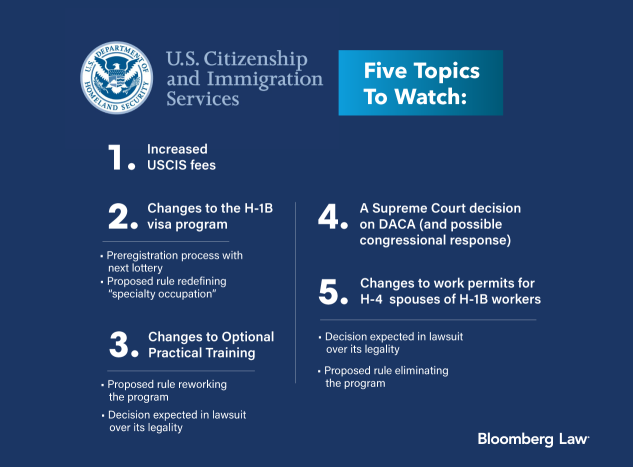
Here are the top five to watch.

USCIS Fees

Applying for a visa will get a lot more expensive. That’s if the final version of U.S. Citizenship and Immigration Services’ new fee schedule looks anything like its proposal—and it likely will. And that fee increase will be especially acute for employers of temporary foreign workers.

The USCIS also is proposing to increase the fee for named workers on H-2A agricultural guest worker visas and H-2B nonagricultural, seasonal guest worker visas while limiting the number of named workers who can be listed on each petition. That means employers seeking large numbers of guest workers will be on the hook for potentially hundreds of thousands of dollars each season.

The proposed rule is a sweeping attack on the United States immigration and naturalization system designed to limit immigration, asylum, and naturalization, with a disproportionate impact on communities of color and non-wealthy immigrants. The proposal includes a plan to transfer over $100 million of USCIS funds to Immigration and Customs Enforcement (ICE), the agency responsible for enforcement.

H-1B Changes

Electronic preregistration for the H-1B lottery becomes official March 1, 2020. Authorized by a January 2019 regulation, the new process will allow employers to enter the lottery for the 85,000 visas that become available Oct. 1, 2020, without having to prepare a full petition and supporting documentation.

Preregistration has the potential to streamline the H-1B application process, but also could cause problems for smaller employers trying to compete for the visas.

Also expect to see a new proposed rule from the USCIS that would redefine an H-1B “specialty occupation” to restrict eligibility to the “best and brightest” applicants. The proposal likely will reflect how the agency already is treating H-1B petitions, but codifying the practice would make it more difficult for businesses to challenge visa denials in court.

DACA Decision

The U.S. Supreme Court likely will rule in June on whether the Trump administration legally ended the Deferred Action for Childhood Arrivals program, which provides deportation protections and work permits to young, undocumented immigrants who came to the U.S. as children.

The justices’ reaction to oral arguments Nov. 12 appears to indicate that the court will back the administration’s curtailment of the seven-year program.

One report by pro-immigration groups estimated that ending DACA will result in an average of 30,000 DACA recipients losing their jobs every month. Another report concluded that removing DACA workers from the economy would cause a $460.3 billion drop in the national gross domestic product over the next decade.

The question remains whether Congress would be willing to pass legislation providing legal status to DACA recipients so close to the election. The House passed such a bill in June, but the Senate hasn’t made any move to take it up.

Optional Practical Training

Optional practical training, which allows foreign graduates of U.S. colleges and universities to work in the U.S., could see big changes next year.

A federal judge in Washington has indicated a willingness to entertain a lawsuit by a group of U.S.-born tech workers who say OPT is illegal and harms their job prospects. The potential for the case to upend OPT recently prompted a wave of amicus briefs.

“Without OPT and STEM OPT, employers would suddenly find fewer STEM-educated persons to take positions in the United States for jobs that cannot be filled with native employees alone,” according to one brief filed by 52 businesses and 11 industry associations.

Immigration and Customs Enforcement, which manages OPT, also has revived its plan to overhaul the regulations governing the program. That change, combined with another proposal to limit how long international students can remain in the U.S., could upend how the program operates in the future—if the courts allow it to continue.

H-4 Work Permits

A longtime Trump administration promise to rescind a program providing work permits to certain H-4 spouses of H-1B workers likely will come to fruition in 2020.

A Homeland Security Department proposal has been under review at the White House Office of Management and Budget since February 2018. The agency now anticipates a spring 2020 release for public comment, which would mean a summer or early fall implementation of the final regulation.

A lawsuit against the program brought by U.S.-born tech workers also recently gained traction when a federal appeals court in Washington said the workers showed that it’s causing them to face increased job competition. Now back with the federal district court, the case could result in a finding next year that the program is illegal.

That would put more than 120,000 H-4 spouses, mostly women from India, out of work.

By Laura D. Francis Bloomberg Law.

By Camilo Moyntoya-Galvez Dec. 31, 2019/ 6:59 AM/ CBS News

DUI Convictions Affect Good Moral Character (GMC) Requirements

Release Date: 
U.S. Citizenship and Immigration Services today announced new policy guidance implementing two decisions from the attorney general regarding how two or more DUI convictions affect good moral character (GMC) requirements and how post-sentencing changes to criminal sentences affect convictions and sentences for immigration purposes.

On Oct. 25, the attorney general decided in Matter of Castillo-Perez  that two or more DUI convictions during the statutory period could affect an applicant’s good moral character determination. When applying for an immigration benefit for which GMC is required, applicants with two or more DUI convictions may be able to overcome this presumption by presenting evidence that they had good moral character even during the period within which they committed the DUI offenses. The term DUI includes all state and federal impaired-driving offenses, including driving while intoxicated, operating under the influence, and other offenses that make it unlawful for an individual to operate a motor vehicle while impaired.

Also on Oct. 25, the attorney general decided in Matter of Thomas and Thompson that the definition of “term of imprisonment or a sentence” generally refers to an alien’s original criminal sentence, without regard to post-sentencing changes. Post-sentencing orders that change a criminal alien’s original sentence will only be relevant for immigration purposes if they are based on a procedural or substantive defect in the underlying criminal proceeding.

“In response to two decisions from the attorney general, USCIS has updated policy guidance on establishing good moral character for immigration purposes,” said USCIS Deputy Director Mark Koumans. “As the attorney general directed, this guidance enhances public safety by ensuring that USCIS adjudicators consider driving under the influence convictions with the appropriate standard of scrutiny.”

Under U.S. immigration law, there are consequences for criminal convictions and sentences that could render applicants inadmissible, deportable, or ineligible for an immigration benefit. Also, certain immigration benefits require an applicant to demonstrate that an alien has GMC to be eligible for the benefit. For example, naturalization applicants must demonstrate GMC.

H-1B Visa Registration

USCIS Implements $10 Fee for H-1B Visa Registration
Release Date: 
The H-1B visa is one of the most critical U.S. work visas as it allows certain professionals performing in a specialty occupation to obtain a 3-year work visa that can be renewed up to six years. The U.S. Citizenship and Immigration Service (USCIS) approves 85,000 cap-subject H-1B visa petitions annually, with 20,000 reserved for U.S. master’s degree positions and 65,000 for bachelor degree positions.
U.S. Citizenship and Immigration Services today announced a final rule that will require a $10 non-refundable fee for each H-1B registration submitted by petitioning employers, once it implements the electronic registration system. The registration fee is part of an agency-wide effort to modernize and more efficiently process applications to live or work in the United States.

The H-1B program allows companies in the United States to temporarily employ foreign workers in occupations that require the application of a body of highly specialized knowledge and a bachelor’s degree or higher in the specific specialty, or its equivalent.

Upon implementation of the electronic registration system, petitioners seeking to file H-1B cap-subject petitions, including those eligible for the advanced degree exemption, will first have to electronically register with USCIS during a designated registration period, unless the requirement is suspended.

“This effort will help implement a more efficient and effective H-1B cap selection process,” said USCIS Acting Director Ken Cuccinelli. “The electronic registration system is part of an agency-wide initiative to modernize our immigration system while deterring fraud, improving vetting procedures and strengthening program integrity.”

The final rule, Registration Fee Requirement for Petitioners Seeking to File H-1B Petitions on Behalf of Cap-Subject Aliens, is effective Dec. 9, 2019, and the fee will be required when registrations are submitted. USCIS is fee-funded, and this non-refundable fee will support the new electronic registration system to make the H-1B cap selection process more efficient for both petitioners and the agency.

USCIS is slated to implement the registration process for the fiscal year 2021 H-1B cap selection process, pending completed testing of the system. The agency will announce the implementation timeframe and initial registration period in the Federal Register once a formal decision has been made, and USCIS will offer ample notice to the public in advance of implementing the registration requirement.

USCIS published a notice of proposed rulemaking highlighting a registration fee on Sept. 4, 2019, which included a 30-day public comment period. USCIS received only 22 comments during that time, and has considered all submissions and offered public responses ahead of announcing the final rule, which is effective on Dec. 9.

USCIS Reaches H-2B Cap for First Half of FY 2020

Release Date: 
U.S. Citizenship and Immigration Services has reached the congressionally mandated cap on H-2B visas for temporary nonagricultural workers for the first half of fiscal year 2020.

Nov. 15 was the final receipt date for new cap-subject H-2B worker petitions requesting an employment start date before April 1, 2020. USCIS will reject new cap-subject H-2B petitions received after Nov. 15 that request an employment start date before April 1, 2020.

USCIS continues to accept H-2B petitions that are exempt from the congressionally mandated cap. This includes the following types of petitions:

  • Current H-2B workers in the U.S. petitioning to extend their stay and, if applicable, change the terms of their employment or change their employers;
  • Fish roe processors, fish roe technicians, and/or supervisors of fish roe processing; and
  • Workers performing labor or services in the Commonwealth of Northern Mariana Islands and/or Guam from Nov. 28, 2009, until Dec. 31, 2029.

U.S. businesses use the H-2B program to employ foreign workers for temporary nonagricultural jobs. Currently, Congress has set the H-2B cap at 66,000 per fiscal year, with 33,000 for workers who begin employment in the first half of the fiscal year (Oct.1 – March 31) and 33,000 (plus any unused numbers from the first half of the fiscal year) for workers who begin employment in the second half of the fiscal year (April 1 – Sept. 30).

For more information, H-2B petitioners can visit the Cap Count for H-2B Nonimmigrants page.


Proposed Two New Rules for Immigrants and Asylum Seekers

On November 14, 2019, the Trump Administration published two proposed rules that will detrimentally impact individuals who are seeking to legally live and work in the United States. One would adjust USCIS’s fees by a weighted average increase of 21 percent, add new fees, and make other changes.

  1.  DHS proposed rule which would make multiple changes to the regulations governing asylum applications and eligibility for employment. See Federal Register / Vol. 84, No. 220 / Thursday, November 14, 2019 / Proposed Rules.

2. DHS proposed rule which would make changes to the USCIS fee schedule. DHS proposes to adjust fees by a weighted average increase of 21 percent,             add new fees, and make other changes, including form changes and the introduction of several new forms. See Federal Register / Vol. 84, No. 220 /               Thursday, November 14, 2019 / Proposed Rules.

Comments on these proposed rules are due December 16, 2019.